New Gear Day

I’m giving my Shavian a bit of a break, and have returned my focus to my other big hobby: music. Though to call it a hobby feels a bit disingenuous – I literally am a professional musician, in the sense that, while it is not my day job, I do get paid to do it. I take pride in my recording- and production work, and try to get the best equipment I can afford to do the job to the best of my ability. This post is about one of my recent new toys.
I had been struggling with reconciling my ambitions with my available gear for a while. My workhorse audio interface had for years been my trusty eight channel Apogee Element 88, but I had outgrown it. I wanted to be able to record drums using more channels, and was not getting the quality or sample rates I was accustomed to with my 24-channel SoundCraft UI24R digital mixer (which is what I use for live shows.) For a good while I was in some sort of purgatory, not willing to upgrade to the Apogee Symphony MkII yet… it was the logical next step up, but I couldn’t quite justify the expenditure.
One of the main strengths of the Apogee Element 88 had always been its amazing pre-amps. And this is why upgrading to the Symphony MkII would be so prohibitively expensive: the Symphony MkII doesn’t come with any pre-amps of its own, so I would have had to shell out cash for two additional 8 channel analog pre-amps to get the extended capacity I was looking for.1
Last year, Apogee announced that they would no longer support the Element 88. I almost pulled the trigger, tempted by the discounted Symphony MkII upgrade they offered me. But then I figured out that I could actually increase my channel count by connecting a second Element unit. I ordered a second-hand Element 46 and the necessary cables to connect the two devices to each other, but I couldn’t get it to work. It turned out that that tethered setup didn’t work on MacOs Tahoe (the latest and greatest), and of course, with Apogee just having discontinued support for the Element Series, they weren’t going to fix the issue.2
Fortunately, I still had an old macBook M1 that was still on an older version of the operating system, so I switched to using it for recording for a while. The setup worked, but it was annoying, for several reasons:
- The old macBook was too slow to work on large projects;
- Plugin management was a pain (why are Waves licences so annoying?);
- The tethered Elements took up both Thunderbolt/USB-C ports on the laptop, so I couldn’t connect any other devices, let alone connect it to a power supply while recording.
Some time passed before I finally figured out that I could simply extend the Element 88 with a single 8 channel preamp – and at a fraction of the cost. The very same optical ports that I was using to tether the two Element Series devices together could be used with any other channel source with ADAT/SMUX outputs. It turned out that there are a number of really good 8 channel pre-amps out there with similarly spec’ed A-D converters, among others: the SSL Pure Drive Octo 8, manufactured by Solid State Logic – of SSL Console fame.
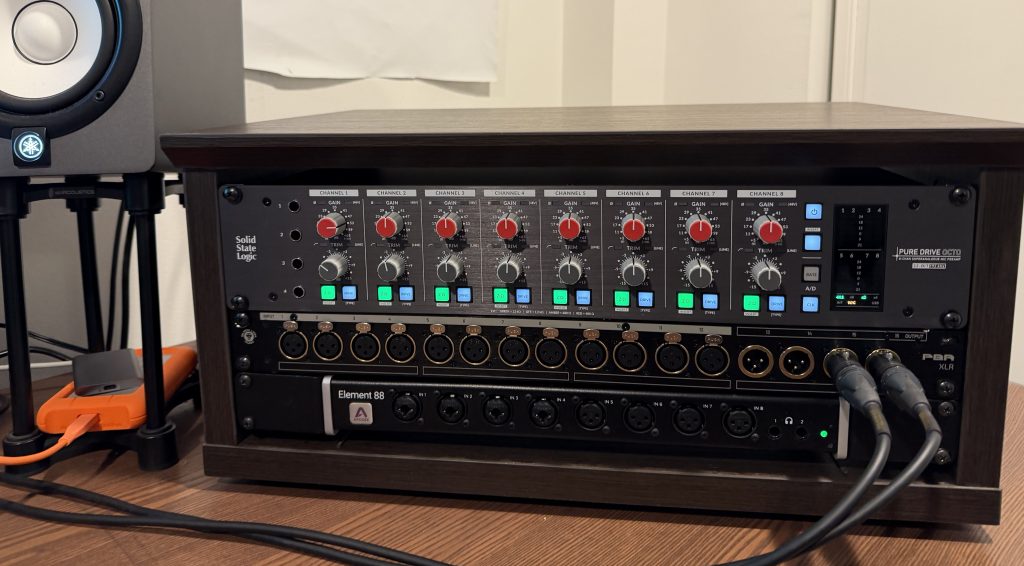
The SSL Pure Drive Octo 8 is a pretty lovely bit of gear. PureDrive™ pre-amp circuitry taken from the SSL Origin with an EIN (Equivalent Input Noise) of -130 dB – just slightly surpassing the -129 dB EIN of the Element Series. Gorgeous channel saturation can be achieved with classic gain + trim tuning, with three different presets (Clean, Classic Drive, Asymmetric Drive). You can colour things further by changing the mic impedance, and the thing can also be used with High-Z instruments.
The SSL PureDrive Octo 8 preamp is not just a traditional eight-channel analog pre-amplifier; it is a modern, hybrid bit of hardware that could function as a stand-alone sound interface in it’s own right, due to state-of-the-art A/D converters, with bitrates up to 192kHz. Or you can send up to 8 channels of 88.2- or 96kHz 24 bit audio over SMUX to an external Audio Interface. Or you can go fully analog, or chain in analog inserts… Up to you.
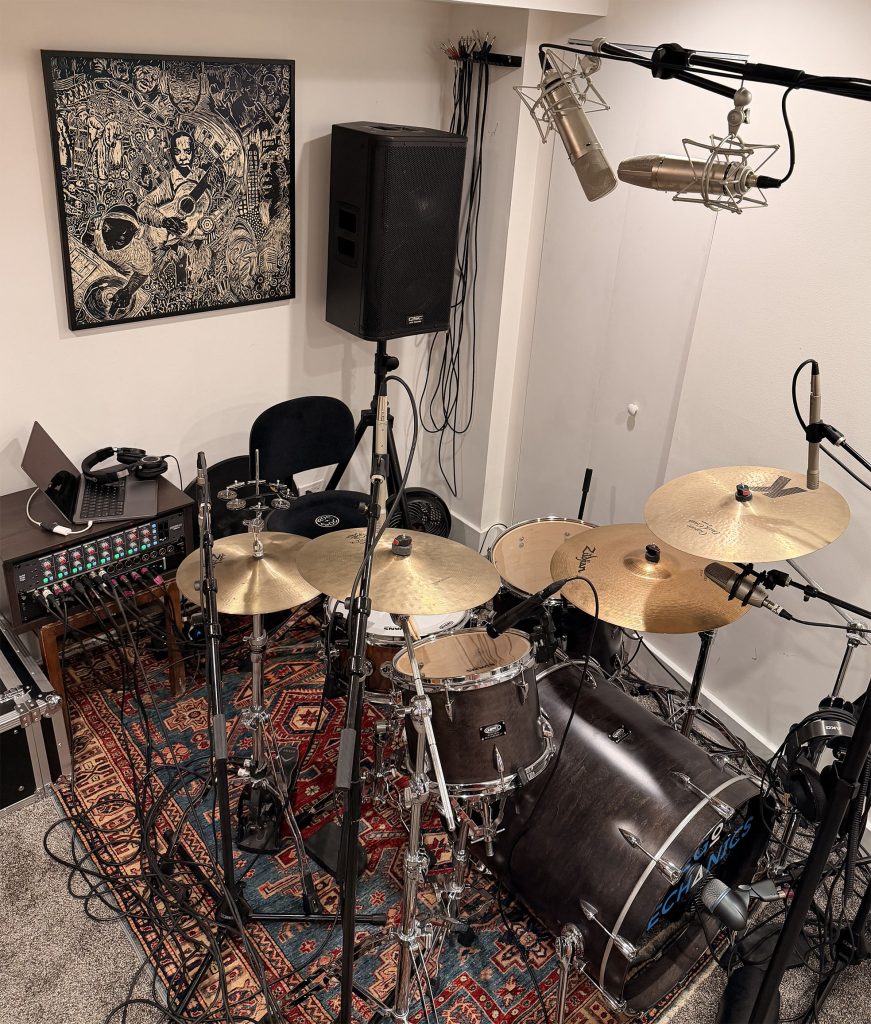
This is barely scratching the surface of the machine’s capabilities, but for my use-case, it adds 8 more channels to my setup with the same sampling rates, signal-to-noise ratio, and latency as the Apogee Element 88. So I ordered one from Sweetwater! And I’ve been loving it – finally tracking drums using 14 channels. I have nothing but good things to say about it so far – can’t recommend it strongly enough!
You may be wondering what I did with the Element 46? Well – it’s almost as though I had planned it this way all along: it now has a permanent home at my mixing desk / console – while the new Element 88 + SSL rig now stays in the live-room, where it belongs.3 I now am pretty content with my recording setup, and will no doubt be able to keep on pushing off an upgrade for another couple of years – at least.4
– Joro
Footnotes
- When you look at it this way, the Element series was too much value for the price Apogee charged for it. Eight channels of high quality pre-amps, industry leading A/D converters with incredible signal to noise ratio, and bundled Apogee FX plugins. And it’s still going strong! ↩︎
- But to their absolute credit, their support team were amazing, and helped me trouble shoot the issue, in spite of their “no longer supporting” the Element series. ↩︎
- Yet another expense saved from the Symphony MKII route: I was spared from having to draw snakes between the control room and the live room, and was able to push off purchasing the requesite patchbays etc. etc.. I’m invariably one of the performers in the live room anyway, so live monitoring from the console is not a luxury I need at the moment, anyway. ↩︎
- I’ve said it before, and I’ll say it again: the Apogee Element 88 is the best music hardware investment I’ve ever made. I bought it about 10 years ago now, and it still is going strong. ↩︎
Leave a Reply