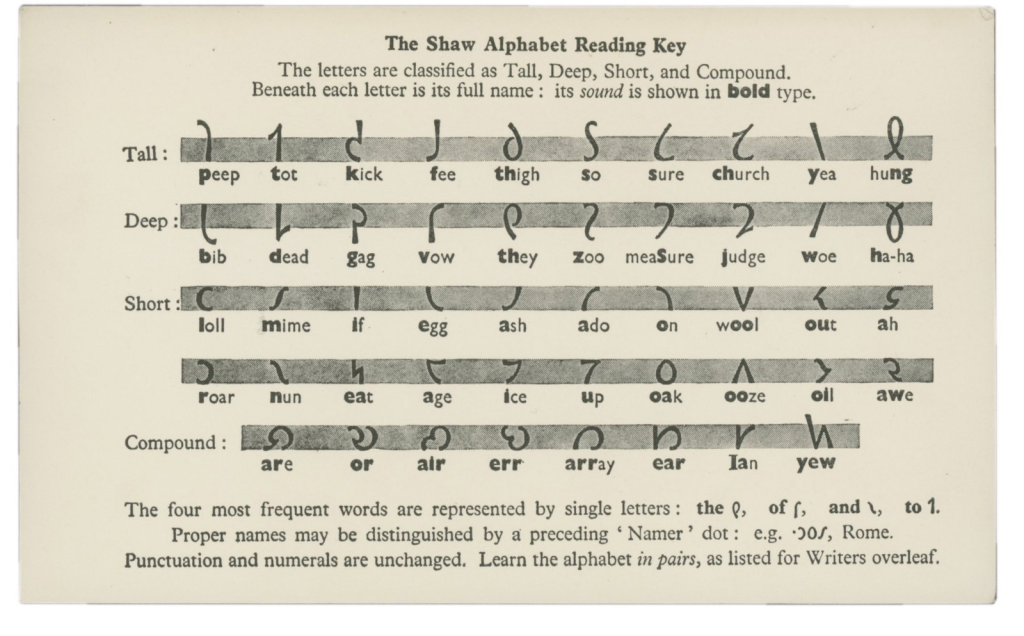
Hello! If you’ve landed on this page, I expect you might be asking yourself: what on earth is Shavian?
Shavian is an alternative alphabet for the English language, that was born out of Sir George Bernard Shaw’s detestment for the inconsistent and inefficient traditional spelling of English using the Roman alphabet. (Shaw referred to that orthography as “Johnsonees”, referring to Samual Johnson, the author of the first ever authoritative dictionary of the English language.)
Shaw didn’t develop the Shavian alphabet himself, but he wrote, frequently and passionately, on the need for a new alphabet, one that would be better suited for the phonemes of English. He rejected contemporary ideas of more modest spelling reform, that would just simplify and regularise the traditional spelling, claiming that anything written that way would just look illiterate. Instead he advocated that we needed an alphabet of at least 40 letters, and went on to describe exactly which phonemes they would need to represent, and even provided test sentences for such an alphabet.
The alphabet that we now call Shavian was not created during Shaw’s lifetime. Instead it was, in a sense, posthumously commissioned by him: he stipulated in his last will and testament that a sizeable amount of his wealth should be devoted to the development, distribution and promotion of a new alphabet following his specifications. The will was contested in court, and the funds earmarked for the development of the alphabet were whittled down substantially. But the executor still fought hard for the cause, and a more modest sum was finally set aside in a settlement, just enough cash to arrange a design contest, to publish and to distribute a book typeset with the new alphabet.
The contest was held, and the jury declared four winners, amongst whom the prize money was split. The four winners were asked to combine forces, and to essentially come up with a Frankensteinian amalgam of their efforts together. Needless to say, that effort didn’t really work out, as the four designers had very different design languages in mind. In the end, the executors opted to go with just one of the four winners, Ronald Kingsley Read. In short order, he and the judges finalised a design that remained more-or-less true to his original intent, while satisfying the stipulations of Shaw’s will that there would not be any multi-letter diphthongs, and the insistence of the judges that each letter should be recognisable in isolation.
The Shavian alphabet was finalised in September 1960, and the Shavian edition of Shaw’s play Androcles and the Lion, was published in November 1962.

A collection of Shaw’s writings on the topic of spelling reform was published as “George Bernard Shaw on Language” by Dr. Abraham Tauber, including a copy of Shaw’s Last Will and Testament, and some court proceedings pertaining to the battle around the funds he had earmarked for the cause.
Far more comprehensive treatises on the origins of Shavian have been given than the above, but none really surpass Leo Phelp’s series of essays. Another good source of illumination of the motivation and origins of the alphabet is the introduction to the Shavian edition of Androcles and the Lion Sir James Pitman. Finally, I’d be remiss not to mention the most authoritative contemporary source of information, shavian.info.