Shavian typing speed
If you’ve played Shaw type, you may have noticed one frustrating aspect of the gameplay: your score is for a great part determined by luck. If you draw short words, you have fewer characters to type, and so your time is shorter, and you end up higher on the leader-board.
This had been bugging me quite a bit. Not only does it turn qualifying for a high-score into a bit of a crap-shoot, but it also makes tracking your own typing speed progress difficult – there is a lot more variance in the results. I could have fixed this issue by changing the game to always give you the same number of letters to type at each level, but that would have been dumb.
The actual problem that needed fixing was the definition of WPM, words per minute. The game was until very recently using the naive, actual number of words typed as the numerator when computing WPM. The more conventional definitions of WPM account for variance in word length by dividing the number of characters typed – including spaces and punctuation – by an approximate average length of an English word – 5 characters is what is usually taken here.
But wait a minute. Shavian words are, on average, shorter than the Roman alphabet equivalent. So surely we can’t use the same denominator? If we want to impress our friends and family, if we want to do an apples-to-apples comparison of typing speed, don’t we need to account for this discrepancy? A Shavian typist will on average type more words with the same number of keystrokes, after all.
I scienced it. Using the word frequency data I use for Shaw-Spell, I figured out that the average word length in shavian is approximately 3.5,1 compared to the Roman alphabet’s 4.5 average over the same corpus. So if we round it up to 4 and 5 respectively, we get comparable numbers, albeit slightly biased in Roman’s favour.
I wanted to switch Shaw-Type to use this scale, but of course, I ran into the problem that the existing leader-boards and progress data were measured using the naive definition. I didn’t want to throw any of this away. So instead, I implemented a dual scoring system. Every time you play a game, it now records both definitions of WPM. The idea is that over time, more and more entries on the leader-board will get the new definitions, and then, one day, I’ll be able to switch everyone over whole-sale (or make the new definition the default.)
If you, like myself, would prefer to time yourself using the new definitions already (bleedin’ edge!), you can: go to burger menu → advanced → use new WPM definition. The one down-side: you then no longer see any old leader-board entries, and your own progress history from before the new WPM definition was rolled out will no longer be visible. (But disabling the feature will show them again.)
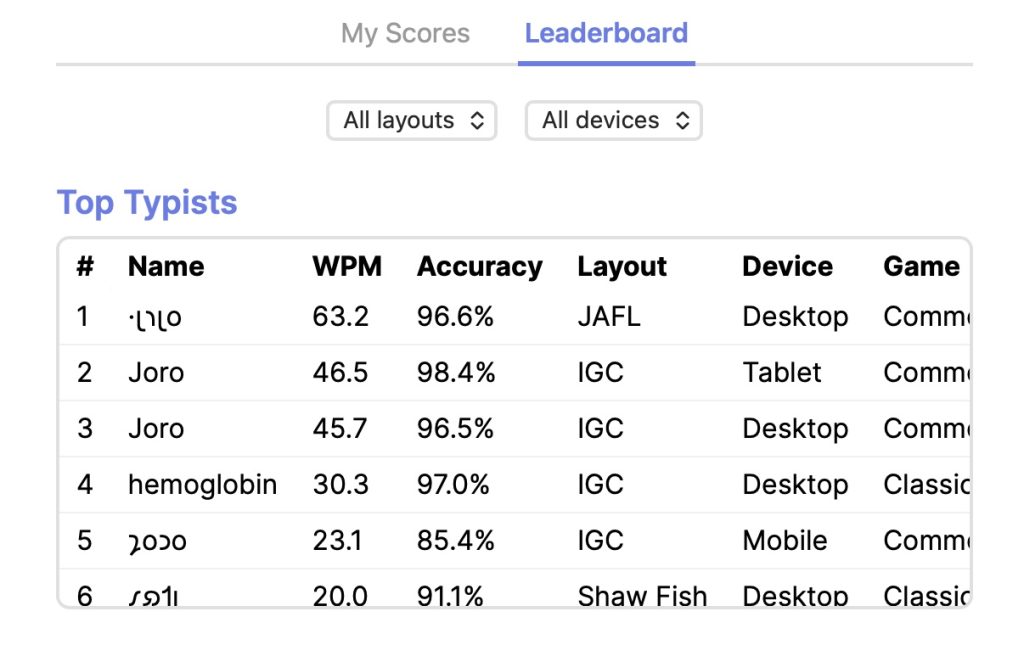
I’ve been using the new setting for a number of weeks, and am very happy to see the variance gone, and to see the classic mode scores land considerably closer to common words. Also very happy to see my WPM slowly but surely creep up (I’m coming for you, ·𐑚𐑪𐑚𐑴!)
– Joro
Footnotes
- In-game, I do not count the extra keystrokes from composing ligatures on keyboards like JAFL and IGC, for hopefully obvious reasons. ↩︎


Leave a Reply