Shaventic coding
It’s been way too long since I posted any updates here, all the more since I posted something in Shavian, so here’s a brief post to tell you what has been occupying my attention over the past couple of weeks.
My efforts in developing shavian tools have not stalled—to the contrary: of late, I have taken to working on multiple frontiers concurrently. As the ai tool-chains have become more and more capable, and one has become more and more adept at controlling them effectively, I have taken to managing four or five agents at once, all assuming an orchestrator role, and managing two or three agents themselves, meaning I often have as many as twenty agents working on the tools at once. Oh, and this is just my home projects—I have many more slaving away for me for my day-job.1
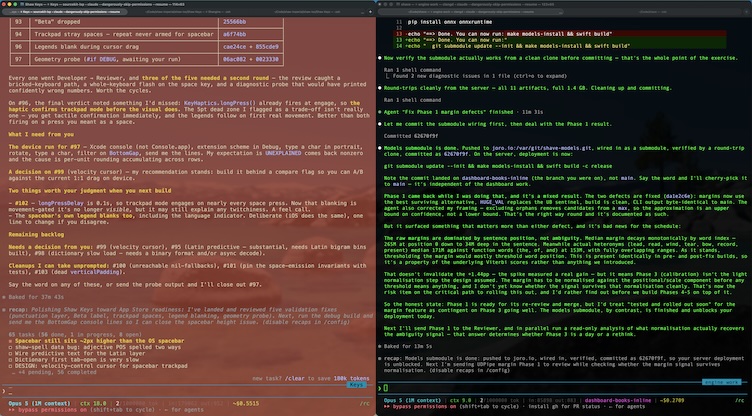
I am experiencing this as being a fine example of the Jevons paradox. As the agentic coding agents become more efficient, we just end up using more and more of them, with the ironic result of me spending more time than ever developing code, not less. But it truly is a productivity boost! I am churning out new tools at an unprecedented rate, both at work and at play, and I am running more experiments and exploratory coding tasks than ever before. I constantly feel as though I am in fact the bottleneck in all of this: my slow prompt engineering and code reviews and validation of new features and bug-fixes is what’s holding my agents back, nothing else.
Sure, they do still need quite some hand-holding – they need very firm guidance and assistance in the realm of architecture in particular, and they really need constant reminding, nagging even, to stick to the game plan and write clean, well tested code. But then, once in a while, they utterly surprise you and bring some really clever and novel solutions to the table, so you don’t want to be too restrictive.
So, what have I been working on with my army of agents of late? In no particular order:
- Adding custom keyboard support to Shaw-keys, and a new way of computing the WPM scores
- Lay-out fixes and improvements for Shave-books’ reader mode
- A wealth of Shave engine improvements.2
- Getting my iOS keyboard and dictionary production ready! Almost, almost…3 this is going to be a big one, watch this space!4
- Building a massive expansion to the Shaw-spell dictionary – several thousand new words added to the base Readlex lexicon, and counting.5 The expansion will include a wealth of new General American and Standard Southern British spellings.
- An OCR project to help me organise and catalogue the letters I scanned from the Pitman collection in Bath, and the Reed collection in Reading.
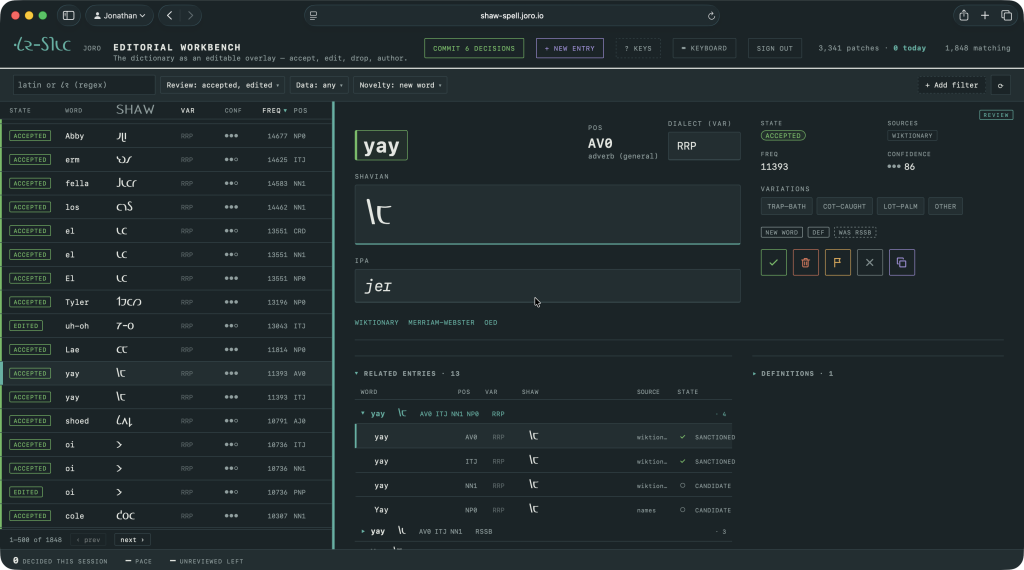
I will be trickling out some of these updates over the next few weeks, probably starting off with the Shaw-type update this week, and the Shave improvements will be close on its heels.
As ever, please keep the feedback and feature requests coming!
Joro
Footnotes:
- Another way of framing this might be: “Hello, my name is Joro, and I have a vibe-coding addiction.” ↩︎
- I’m really excited about this one, and will probably post about it in detail in the near future. Let’s just say that homograph mistakes are going to be much more rare in the forward transliterator in the near future, and Shave will surface more and more decisions with a useful confidence verdict. ↩︎
- Here too, there is a really cool tech stack i’m very excited about, including a very capable spell-checking and predictive text, and being able to invoke the Shaw-spell dictionary from anywhere on your iPhone or iPad. ↩︎
- When the launch gets close, I will want to enlist some beta-testers for this! If you are an iPhone or iPad user, please give me a holler! ↩︎
- I have a wonderfully over-engineered pipeline for the editorial process, that includes the use of several home-grown neural modals to help in triangulate the correct IPA and shavian spellings of words. ↩︎
Leave a Reply